Eating Over the Keyboard Is a Scam: Reclaiming the Midday Meal Your Brain Is Owed
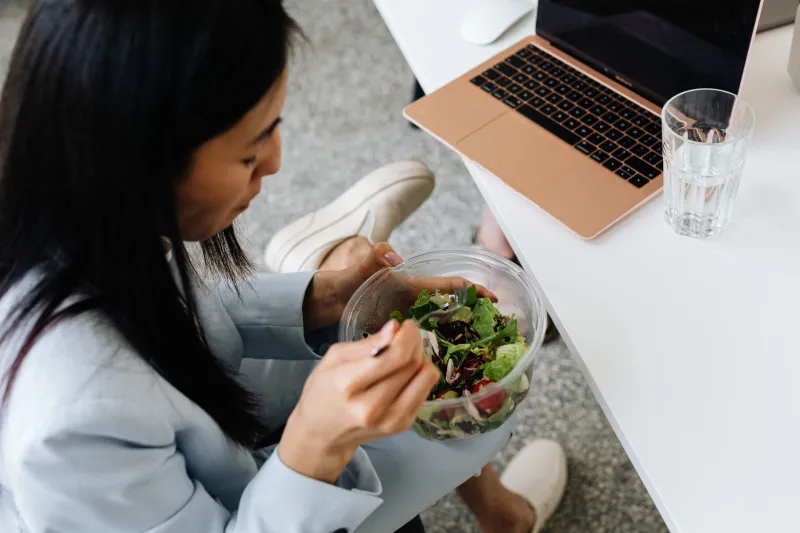
Somewhere in the last twenty years, lunch stopped being a meal and became a rumor. You know the routine: a sad salad balanced on a stack of napkins, one hand typing, eyes glued to Slack. The desk lunch isn't a quirk anymore — it's the national default. And it's costing you the best hours of your day.
The Desk Lunch Is a Cultural Artifact, Not a Necessity
We talk about the American work ethic like it's some sacred inheritance, but the desk lunch is actually a pretty recent invention. It grew out of a culture that started treating busyness as a personality trait — where stepping away from your screen for an hour reads, to the paranoid eye, as slacking.
Meanwhile, much of the world never got the memo. In France, the midday meal is still a genuine event — a pause with a beginning and an end, not a task to be optimized. In Japan, office workers treat their bento with a level of attention most Americans reserve for quarterly earnings reports. In Spain, the afternoon doesn't even pretend to start until lunch has properly happened.
The difference isn't laziness or wealth. It's a belief about what recovery is for.
What the Science Says About Your Sad Sandwich
Here's the uncomfortable part: the research on midday breaks is about as one-sided as it gets.
Studies on attention consistently show that sustained focus degrades over the course of a morning, and that genuine disengagement — stepping away, changing environments, doing something unrelated to work — is what restores it. A 45-minute break where you actually eat, maybe walk, maybe talk to a human being, functions like a system reboot. Eating at your desk while answering emails gives you none of that. Your attention never clocks out. You're just doing two things badly instead of one thing well.
There's also the digestion problem, which sounds trivial until you realize that eating while stressed literally impairs how your body processes food. The desk lunch isn't just bad for your afternoon — it's mildly bad for your body.
And for those of us who care about flow states, the stakes are higher still. Flow requires a brain with enough recovery runway to engage deeply. Skip the midday reset and you're asking your brain to run a marathon on a five-minute stretch. That 2PM fog you've accepted as normal? It's not a biological law. It's a bill coming due.
The 45-Minute Playbook
So how do you rebuild a lunch habit in a culture that glamorizes eating over the keyboard? Start small and be strategic.
1. Physically leave the desk. Doesn't matter where — a break room, a bench outside, your car. The physical relocation is the signal your brain needs that the work block has ended.
2. Eat without a screen. This is the non-negotiable. A podcast or a real conversation is fine. Email is not. The point is giving your attention somewhere else to live for half an hour.
3. Add one non-work pleasure. A short walk, a chapter of a novel, people-watching. This is what turns a food break into a recovery break.
4. Protect it socially. Block it on your calendar as a real meeting — because it is one, with yourself. If someone asks, "Busy?" the honest answer is yes.
5. Track the afternoon, not the lunch. For two weeks, jot a quick note at 4PM about your energy and focus. The data will make the argument better than any productivity guru could.
The Counterintuitive Part
The fear, of course, is that stepping away means falling behind. But anyone who's actually done this knows the math works the other way. Forty-five minutes of genuine recovery routinely buys back two or three hours of sharper afternoon work. The desk lunch doesn't save time — it just spreads your exhaustion across more hours.
There's something almost funny about it. We'll spend hundreds of dollars on supplements, standing desks, and productivity apps, all in pursuit of better focus. Meanwhile the single most effective intervention is sitting right there on your plate, waiting to be eaten somewhere other than your desk.
Your lunch break isn't dead because you don't have time. It's dead because nobody ever told you it was worth fighting for.
Consider this the memo.