4PM Doesn't Have to Be the End of Your Day — Here's What That Crash Is Really Telling You

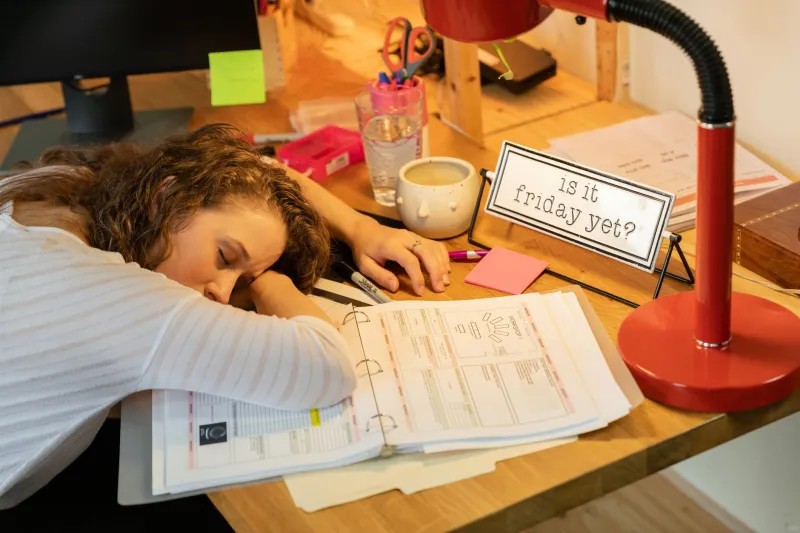
It's 3:47 PM. You've read the same email four times. Your eyelids have opinions. And somewhere in the back of your mind, a little voice whispers: you need caffeine. You need a snack. Something is wrong with you.
Nothing is wrong with you. And no, you're not broken, lazy, or secretly deficient in whatever supplement TikTok is pushing this week.
The afternoon crash — that foggy stretch between roughly 2 and 5 PM that hits desk workers from Seattle to Miami — isn't a fuel problem. It's a mode problem. Your brain isn't asking for more input. It's asking for a different kind of output.
The Crash You've Been Fighting Is a Signal, Not a Flaw
Here's what's actually happening under the hood. Your circadian rhythm doesn't run on a single 24-hour wave — it has natural dips and peaks throughout the day. The post-lunch trough is baked into human biology, and it's been observed across cultures, professions, and even people who skip lunch entirely. So no, that burrito isn't solely to blame.
During this dip, your brain shifts its emphasis. The alert, focused circuitry that carried you through your morning meeting starts handing things off to a more diffuse, reflective mode. Neuroscientists sometimes describe this as the balance between focused attention and the brain's default mode network — the system that lights up when you daydream, reflect, and connect ideas loosely.
Most of us spend the afternoon doing the exact opposite of what our brains want. We double down on the same kind of work — more emails, more spreadsheets, more grinding — and then wonder why everything takes twice as long. It's like driving with the parking brake on and blaming the engine.
The slump, in other words, is your brain politely requesting a state change. We usually respond by pouring more espresso on the problem, which is a bit like yelling at your GPS for recalculating.
Why Snacking and Coffee Make It Worse
The default American response to the 4PM wall is a vending machine run or a third (or fourth) trip to the office Keurig. Both feel like fixes. Both actually deepen the cycle.
Caffeine taken in the late afternoon doesn't just wake you up — it sticks around. With a half-life of five to six hours, that 4 PM cold brew is still partying in your bloodstream at 10 PM, quietly degrading the sleep that determines how rough tomorrow's slump will be. Congratulations, you've just enrolled in a subscription service for chronic exhaustion.
Sugary snacks work the same way in fast-forward: a quick glucose spike, a satisfying fifteen minutes, then a crash that lands you lower than where you started. Your blood sugar becomes a rollercoaster, and your focus becomes a passenger.
The real issue? Neither of these addresses the actual request your brain is making. It doesn't want stimulation. It wants variation.
The State-Change Protocol: Three Moves for a Second Wind
Instead of fighting the dip, work with it. Here's a simple protocol you can run in under fifteen minutes:
1. Get light in your eyes — real light. Step outside for five minutes, or at minimum park yourself near a window. Afternoon daylight signals your circadian system to bump alertness back up naturally. Think of it as a free, side-effect-free espresso. Even on gray January days in Chicago, outdoor light massively outperforms your office fluorescents.
2. Move your body, even briefly. A brisk ten-minute walk, a flight of stairs, a few stretches in the parking lot — anything that gets blood moving. Movement isn't just a distraction; research on walking breaks consistently shows boosts in creative thinking and mood. This is part of why your best ideas show up on walks, not in spreadsheets.
3. Swap your task type, not your effort level. This is the big one. If you spent the morning on focused, analytical work — writing, coding, number-crunching — the afternoon dip is a terrible time for more of that. But it's a great time for a different cognitive mode: brainstorming, organizing, returning calls, sketching ideas, doing the low-stakes busywork you've been avoiding. Match the task to the mental state instead of forcing the state to match the task.
Run these three in sequence and something interesting happens: the slump doesn't disappear, but it stops being a wall and becomes a doorway into a genuinely productive second window.
Rethink What the Afternoon Is For
There's a deeper shift available here, and it's this: stop grading your afternoon by morning standards.
Flow states and deep focus are easiest to access in the first few hours after waking, when alertness is naturally high. That's when you should schedule your hardest, most meaningful work — the report, the pitch, the thing that matters. Protect those morning hours like they're sacred, because they are.
The afternoon, then, isn't a failed morning. It's a different animal entirely. It's suited for connection, admin, ideation, planning tomorrow, and collaborative work — tasks that benefit from the looser, more associative headspace the dip naturally provides. Cultures with strong afternoon rhythms have understood this forever; the Spanish paseo and the Italian riposo aren't laziness, they're state changes with centuries of field testing.
When you stop expecting 4 PM to feel like 10 AM, the guilt evaporates. What's left is a workable stretch of time that just needs to be used differently.
Your New 4PM Playbook
- Morning: Deep, focused work. Guard it fiercely.
- When the slump hits: Light, movement, task swap. No caffeine after roughly 2 PM.
- Afternoon: Administrative work, brainstorming, meetings, planning — anything that isn't a clone of your morning work.
- Evening: Let caffeine-free wind-down protect your sleep, so tomorrow's morning focus is even sharper.
The 4PM slump was never your enemy. It was a message you kept misreading — and answering with more coffee, more sugar, more of the same. Change the state, and you might discover the most productive hours of your day were hiding in the place you wrote off years ago.